Category: research

  • How TinyUTM works as an UTM

    Nine parameters have been selected as the minimal, necessary and sufficient whole to characterize metals, polymers and composites at room temperature. In accordance, the .JSON schema for TinyUTM has been devised as follows:

    {
    “materials”: [“Metal”, “Polymer”, “Composite”],
    “tests”: [“Tension”, “Compression”, “Flexural”, “Fracture”, “Small-Punch”],
    “specimens”: [“ISO Compliant”, “Custom”],
    “test_speeds”: [0.5, 1.0, 2.0],
    “parameters”: [“yield_strength_MPa”, “ultimate_tensile_strength_MPa”, “youngs_modulus_GPa”, “elongation_at_break_percent”, “flexural_strength_MPa”, “flexural_modulus_GPa”, “fracture_toughness_KIC_MPa_sqrt_m”, “JIC_kJ_per_m2”, “energy_to_fracture_J”],
    “advanced_parameters”: [/* in case of expansion */]
    }

    This .JSON is a fundamental, static implementation of ASTM standards, specimen dimensions, material categories and property ranges. On top of that , a .csv file will store the original raw data from every test in the form of: load, displacement and time for post-processing. Any mechanical parameter of interest in materials science can be devised from that numerically, once the test setup is known, therefore a .csv file will be the primary output of TinyUTM as a universal testing machine. In addition, a database of benchmarks from validated literature acts as reference for any post-processing.
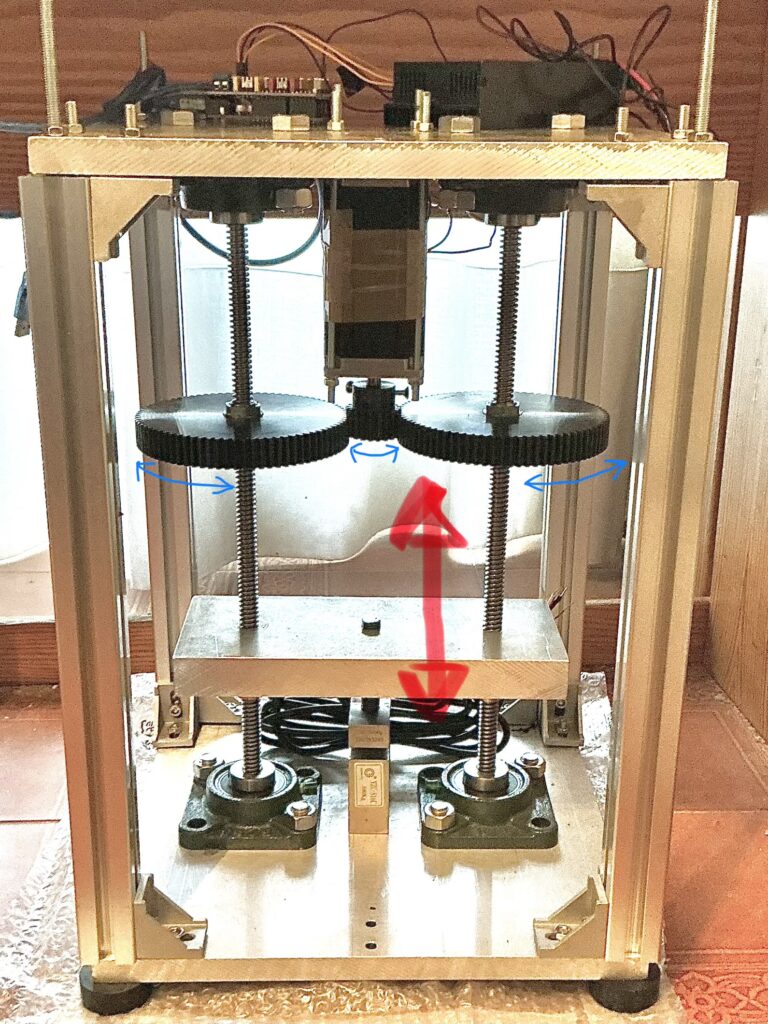
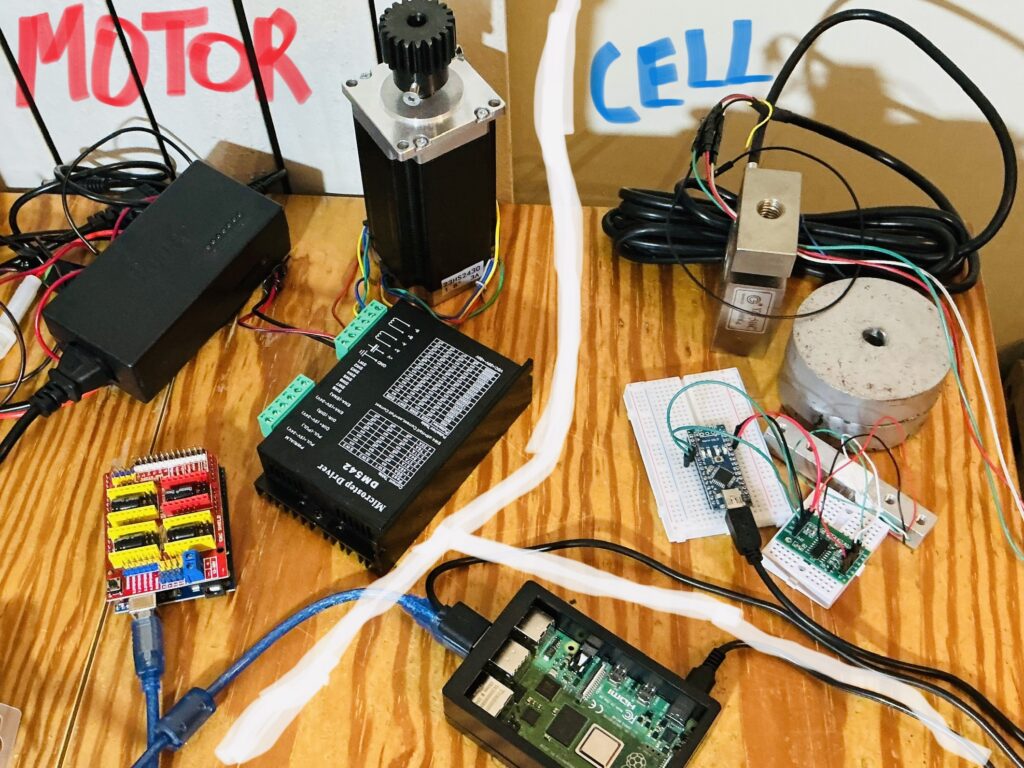
  • TinyUTM’s original reference

    Our very first TinyUTM’s idea in late 2024 was aimed at reproducing the open-source FreeLoader’s work by Amend, McNicoll and Lipson, 2011, University of Columbia, paper reference: “FreeLoader: An Open Source Universal Testing Machine for High-Throughput Experimentation“, ASME IDETC/CIE Conference, Washington, DC, 2011. Other than tensile tests of non-metal and/or additively manufactured specimens, we wanted to try the recent small punch test for metals, all within a 3kN load capacity instead of their 5kN.

  • AI steels R&D needing TinyUTM

    FOUR INTERESTING MATERIALS FOR 2025

    The following materials, still at an early or mid technological readiness level, can be prepared and tested in-house for preliminary R&D work or dissemination purposes, employing a metallurgy lab (5 kN universal testing machine with small punch test addition + small tube furnace + modified 3D printer for injection molding + standard lab equipment) worth as little as 5k euros:

    • Fe-18Cr-8Ni-2Mn-1Cu-0.1N (austenitic stainless steel): automotive applications;
    • Fe20Cr20Ni20Mn20Co20 (Cantor high entropy alloy): similar to austenitic steel, space applications;
    • 70% PLA + 20% PHB + 10% limonene as plasticizer (bioplastic): packaging applications;
    • PLA with 2% graphene nanoplatelet (conductive polymer): electronics applications.

    There are no non-standard risks associated, so any qualified operator should be able to process the materials and execute the tests by following checklists for safety and for the reliability of results.